How I Work.
Four disciplines. One operating approach.
Right people. Right seats.
As a producer, I'll often inherit an idea already in motion. Other times I'm building from scratch, assembling the creative idea and the team as we go. Regardless, my first goal is always to create shared language and get teams rowing the same direction.
At Cornerstone OnDemand, I was Studio Production Manager: responsible for managing projects across multiple producers, time zones, and production disciplines. Some were vertical TikTok-style series. Others were thoughtful roundtable discussions. I managed a budget exceeding $1M, wrote the briefs, and hired and directed the outside agencies and freelancers who filled the gaps, shipping ten award-winning series and 15 Telly and Anthem Awards.
Today, that same operating discipline can scale both ways. I can lead a full production team across directors, editors, designers, and post. Or I can shoot, cut, and publish on an iPhone in an afternoon. The skill isn't picking a side; it's knowing which mode the work actually needs. While the toolkit may change, the job stays the same: get the team aligned, remove friction, and deliver meaningful work.
"Coming together is a beginning. Keeping together is progress. Working together is success."
— Henry FordThe H Files: production process for a 20-episode animated series at Cornerstone OnDemand.
Story is the whole stack.
The best stories are built, not just told. It's the idea, the audience, the title, the key art, the trailer, the press hit, the social cutdown, and the way all of it points in the same direction. The ideas that work are the ones where development, brand, and edit are part of the same conversation from day one.
I started my career as an editor, so I'm constantly looking for the spine of a story early. In development, in casting, in the brand wrapper. By the time we're in the timeline, we're refining, not rescuing. What scene is going to carry the trailer, what line is going to live on the poster, what story we're actually telling versus the one in the script. Not Just a Goof, an independent documentary I produced, found its audience that way. A clear idea, a clear voice, and brand work that earned attention before the film even launched. It landed on Disney+ at #3, scored 100% on Rotten Tomatoes, and was nominated for an Annie Award.
"The role of a storyteller is to make the audience care."
— Andrew Stanton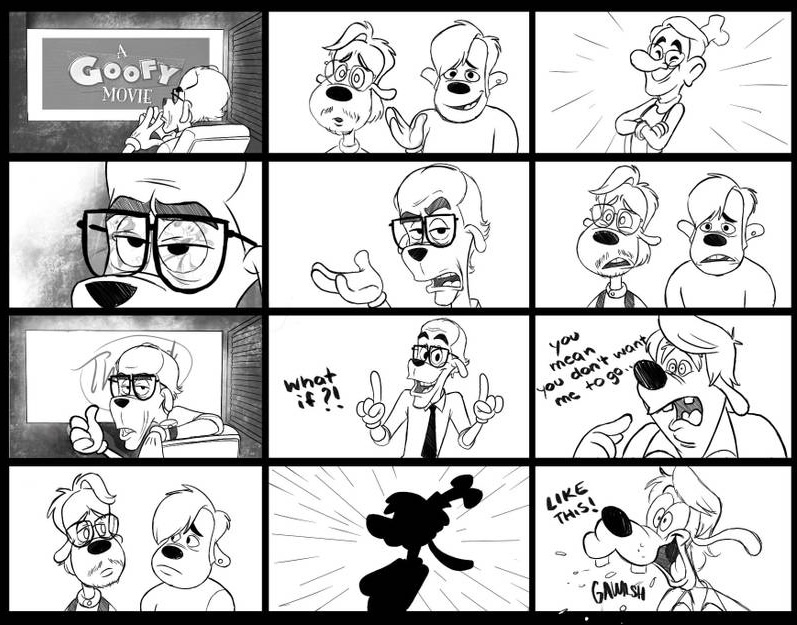
Not Just a Goof (Disney+). Feature documentary I produced from development through delivery, including key art, trailer, and brand campaign. Annie Award nominee, 100% Rotten Tomatoes.
Great process makes the next decision obvious.
A production system is the part of the work nobody sees: how a brief comes in, who owns it, where the review happens, and what has to be true before anything ships. I've built them from scratch for a 20-episode animated series across five time zones, a daily news pipeline, and dozens of projects between.
Every project runs the same arc: establish clear goals, communicate early and often, align costs and timelines, trust the people doing the work, escalate problems as needed, and follow through until the last detail is delivered. The tools change from job to job, but the principles of running a great project are consistent.
As far as AI goes, it is three things in my workflow: a creative collaborator, a multiplier, and a production utility for those unglamorous tasks. At the end of the day, I still own the taste and the final call.
"All art is dependent on technology because it's a human endeavour — even when you're using charcoal on a wall, that's technology."
— George LucasStart small. Find your people.
Every audience I've built started small. A few PowerPoint slides turned into a seventy-event tour and, eventually, a global movement. A pilot nobody asked for, shot in a corporate office closet, became an award-winning three-season series. A single interview turned into an independent documentary with no money or studio behind it, found its audience through a grassroots campaign, and is now available to over 150 million on Disney+. Time and time again the pattern stays the same: make something people care about, learn why they cared, and then do it all again.
Today one of the fastest places to reach an audience is through vertical video. It has its own language, with face-forward framing, three-second hooks, sound-off readability, and swipe-driven pacing. The rules aren't borrowed; they're being written right now. At Cornerstone I produced DNA: Digital Native Advancement, the first vertical-first educational series built for Gen Z. Now I work in the medium daily and read the numbers like an editor reads notes: our top Shorts hold a 64% average view duration, a benchmark most editorial content doesn't hit. The first frame is just the hook. Everything after has to earn its place.
"I would have written a shorter letter, but I did not have the time."
— Blaise Pascal, Lettres Provinciales (1657)DNA: Digital Native Advancement: vertical-first learning series produced for Gen Z at Cornerstone OnDemand.
Build things that outlast you.
The work matters. The recognition matters. But what I most want to be true twenty years from now is that the people I worked with say I built them up to do great work.
A producer's job is to empower the creatives making the thing. The process is part of what gets built. That's the job.